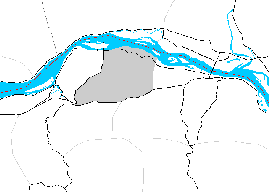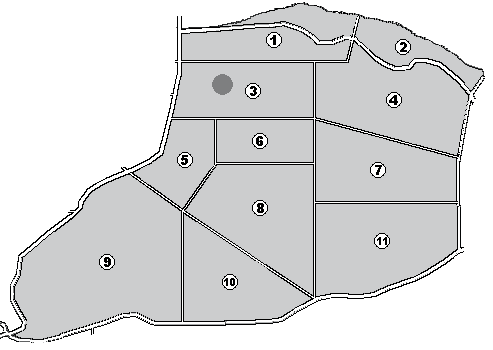
Metro Superior is made up of the area east of the JFK Expressway and represents much of the new development that emerged in the city's growth after the 1951 disaster.

Shipyards, docks, and warehouses dominate the Downtown area. There are also several low-income housing developments and apartment blocks. The southeastern quarter is home to Superior City's Japanese neighborhood, known as Little Tokyo to the locals.
The western portion of Riverside is the site of several small docks and warehouses and is the site of Superior City's Chinatown. The waterfront is also home to Riverside Park. The southern part of the district is home to the Columbia Community College and the surrounding blocks consist of student housing and book stores.
As a result of the economic boom in the wake of the 1951 disaster Midtown has become the business and financial center of the city. Dominating the skyline is the huge central building of D.W.E. Plaza, the central headquarters of Dark World Enterprises, referred to by city residents as the "Dark Tower". Several other impressive skyscrapers litter the landscape of the City Center, most notably the twin edifices of Samson Towers (or the Two Towers) at the heart of the financial district. At the center of it all is Century Center, the Superior City Metropolitan Complex (a.k.a. "The Metroplex"), a massive business, entertainment, shopping and transportation complex. The Metroplex consists of a transit center that combines a railway and bus station, a sports complex and fitness center, a hotel, three office towers, a conference center, and a massive three-story mall. Rising above the complex is the 1,500-foot spire of Century Tower and the whole thing is built above the underground two-story central transit station that forms the core of the SPARTaN rail system. For additional information see the Metroplex section.
Consisting of shoddy tenement apartments and urban housing developments, the East End is one of the worst areas of the city, eclipsed only nearby Hell's Gate. Unemployment, drugs, gangs and crime run rampant in the area. The northwestern corner is Little Saigon, where many of the city's Vietnamese residents live. Together with Chinatown in Riverside and Little Tokyo in Downtown these areas form the "Oriental District" of Superior City. See the Oriental District section for details about the area. The central part of the East End is called the Barrio and is home to a large Hispanic population while the northern portion, known as Little Odessa, is home to ethnic Russians and Ukrainians.
Olympic Park was the run-down district that was to be home to the 1956 Olympic games. The area consisted of the unfinished athlete's village, track-and-field venues, and parks. Olympic Park had become home to the area's homeless population and gangs constantly fought over control over the park "turf". Disputes over ownership, zoning, and construction rights prevented the reconstruction or redevelopment of the area after the 1951 disaster, but these disputes have mostly been resolved and the area was re-zoned to become the site of a World's Fair. Construction of the fair was stopped when a series of mysterious disappearances led to the area being sealed off by the D.E.O. for a short while with no one being allowed in. Eventually the D.E.O. reopened the area and construction has once again started on the Superior City World's Fair and Exposition. The D.E.O. never explained why they sealed the area, but there are rumors of the discovery of a strange dark pit, perhaps a remnant of the Ultra-Humanite's "darkness globe" scheme from the previous year. Whatever it was the D.E.O. seems to have dealt with it, though there are stories among the fair ground workers of a pitch-black phantom that supposedly haunts Olympic Park.
Cathedral Hill is so named because of the presence of the Cathedral Church of Saint Thomas Aquinas, a towering gothic church and monastery. The Cathedral was built on the site of a Catholic mission built in 1850 by Spanish priests that had traveled from California. The Cathedral itself is in the middle of the district while the rest of the area is split between shopping and entertainment in the west and residential areas in the east.
Hell's Gate was originally called Steeltown and was the site of many of the city's industrial factories prior to the 1951 disaster. In the recovery and economic boom period following the disaster the factories began to move south to Aurora abandoning the area. An attempt to turn the area into an urban housing project in the 1960s was a dismal failure. Today Hell's Gate is a maze of burned-out tenement buildings and abandoned industrial sites. The area has become home to the worst of the disenfranchised and criminal elements of the region. Nobody lives in Hell's Gate voluntarily and city has effectively written off the whole district. There is no water, electricity, or phone service in Hell's Gate except what is hijacked from the city's infrastructure by the district's residence. The area is divided into medieval-like "kingdoms" controlled by various gangs and criminal groups. There are continuous battles for territory and the scant resources available. As a general rule, the police don't go into Hell's Gate, especially after dark.
The northern and western portions of the Centennial District, bordering on Cathedral Hill and Olympic Park, make up the city's entertainment district. Bars, nightclubs, theatres, jazz clubs, and movie houses dominate the area. The eastern end, however, provides a different sort of entertainment. Near the border with the Hell's Gate is Superior City's Red Light district, home to strip clubs, sleazy bars, and cheap hotels. Towards the south the Centennial District turns into suburbia with several housing developments mixing with those in the Triangle and Edgeworth.
Southgate is a residential district heavily populated by the blue-collar workers employed in the factories and mills in Aurora.
The Triangle is mainly a residential area with several housing developments that are home to workers from Aurora and Meridian. The southern part of the district, along the Waid Expressway, has several theme restaurants as well as a megaplex movie theater.
Edgeworth is another residential area. The housing market here is geared toward the white-collar workers from Aurora's industrial companies and the high-tech firms in Meridian.